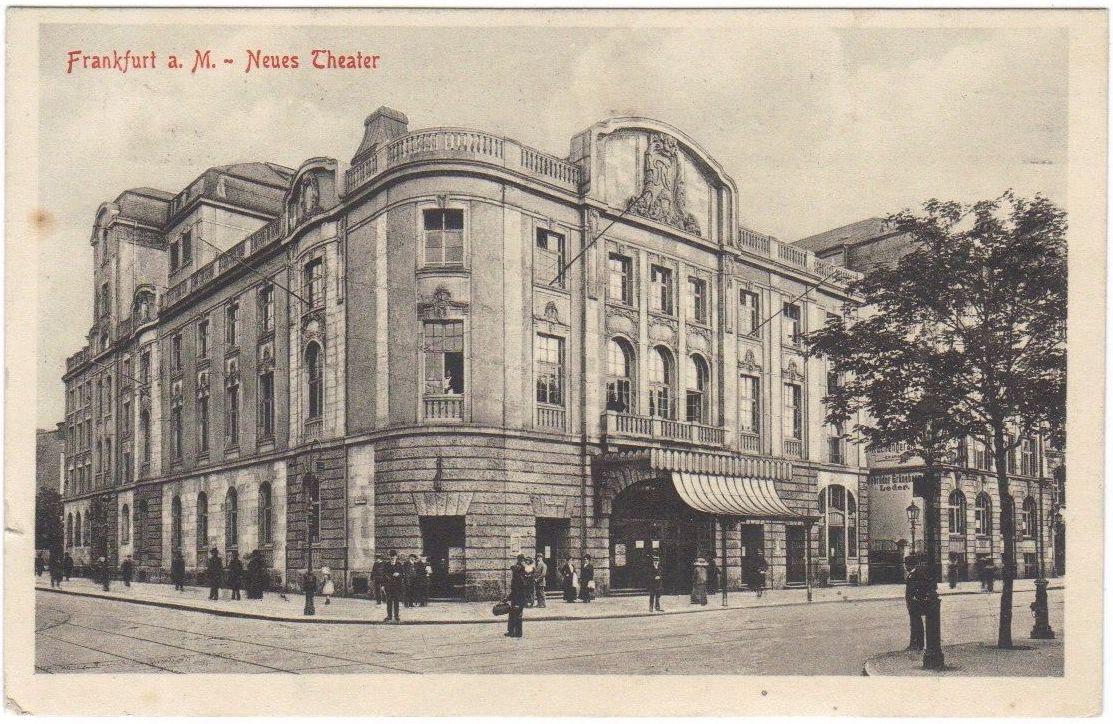
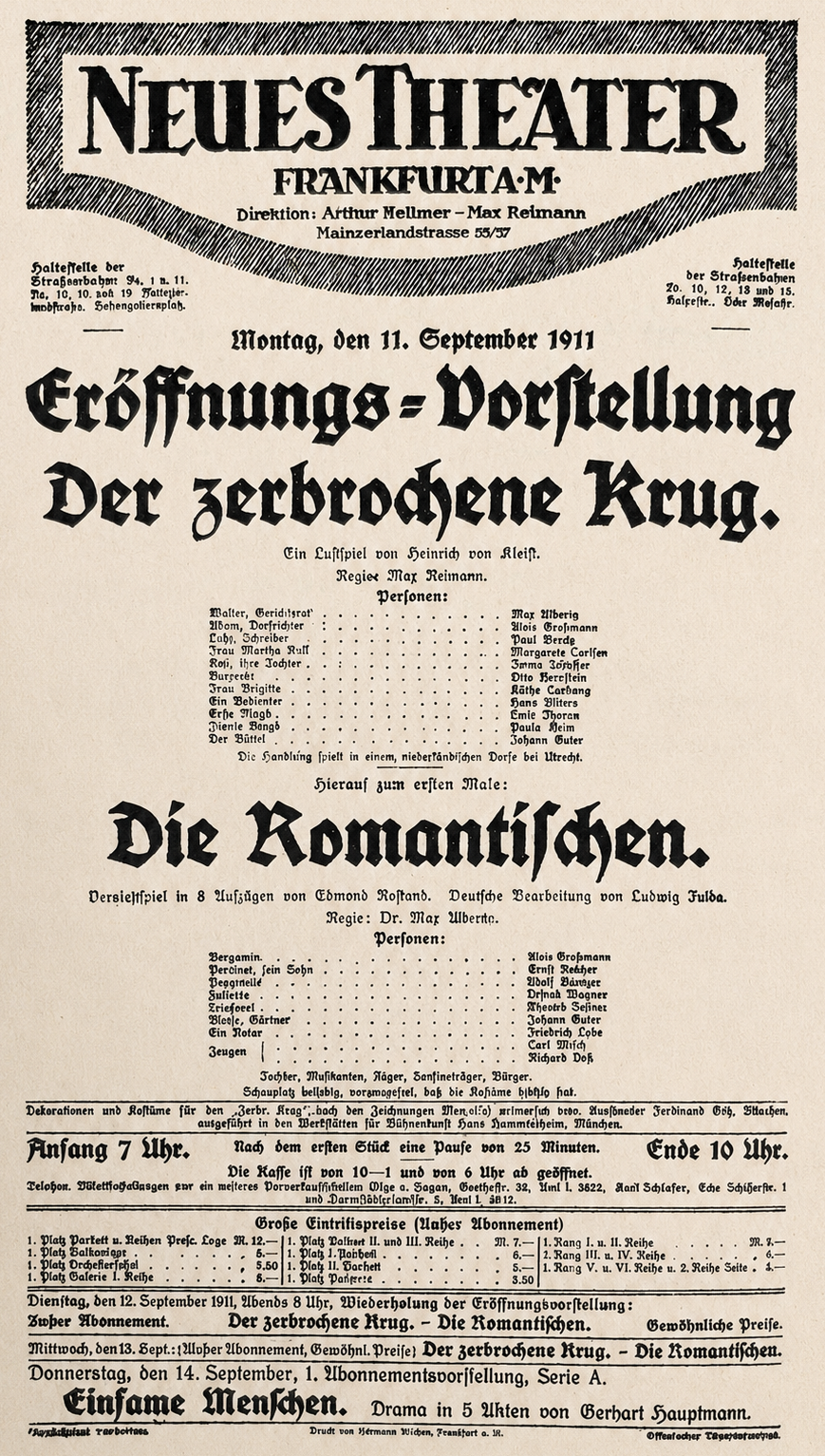
In 1910 Arthur Hellmer formed a company to build the Neues Theater at Mainzer Landstraße 55, financed largely by donations from the city's affluent bourgeoisie — among them the banker Maximilian von Goldschmidt-Rothschild, then reputed to be the wealthiest man in the German Empire. The house opened on 11 September 1911 with Kleist's Der zerbrochne Krug.
A quarter-century of premieres
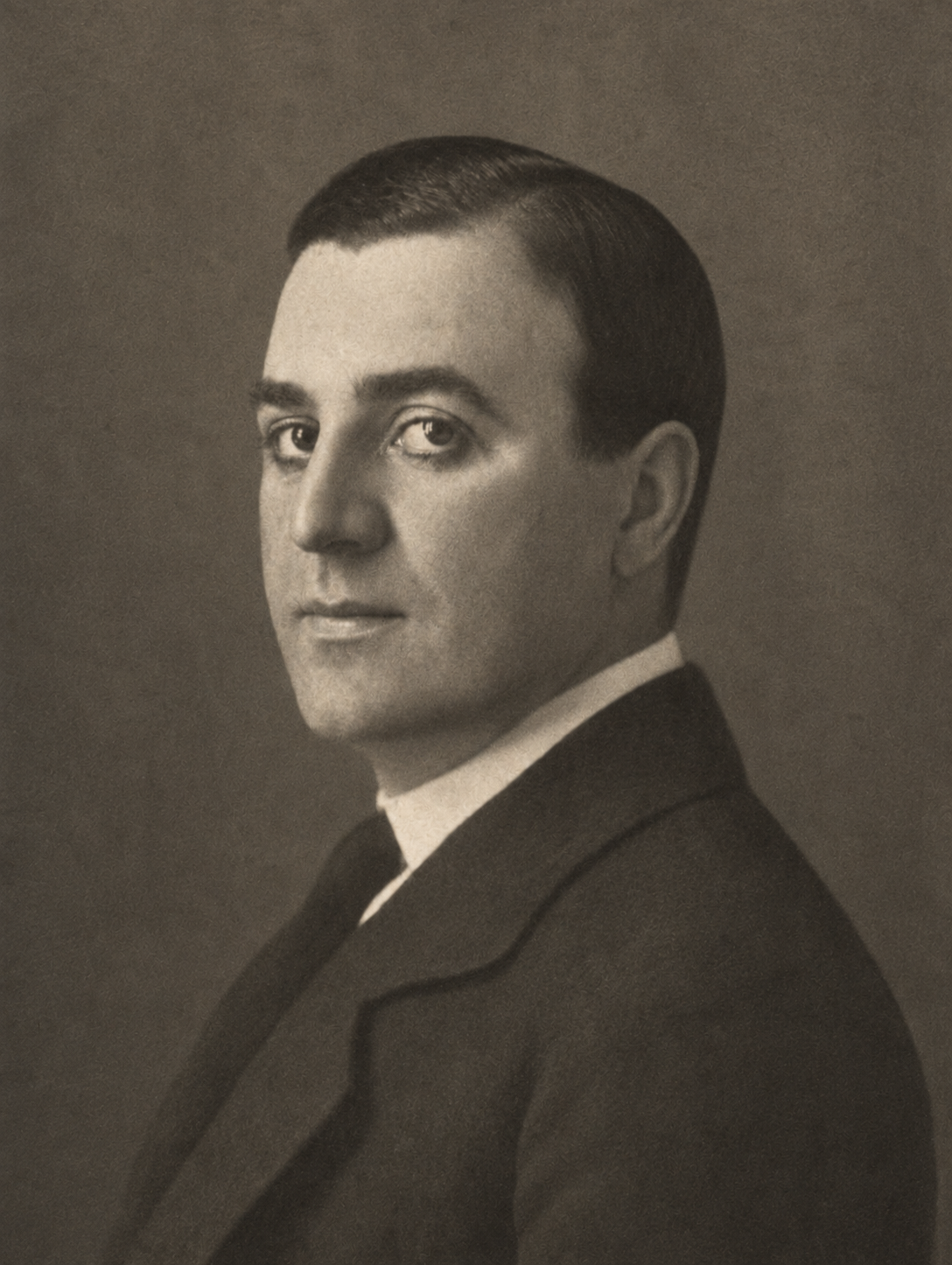
Hellmer co-directed the house with Max Reimann until 1920, then ran it as sole owner and director until 1935 — twenty-five years in all, with more than nine hundred premieres, many of them German or world firsts. The Neues Theater became one of Europe's most successful private theaters, admired far beyond Frankfurt for its modern repertoire and its nurturing of a generation of actors.
In parallel he founded the Frankfurter Kammerspiele (leading them 1920–22) and the theater journal Der Zuschauer (1919), and in 1925–26 produced in Berlin at the Lessing-Theater, the Trianon-Theater, and the Kleines Theater.
Writers and ensemble
Hellmer championed modern and expressionist drama, working with — and premiering — Georg Kaiser (Die Bürger von Calais, Die Koralle), Arthur Schnitzler, Stefan Zweig, Bertolt Brecht, Carl Zuckmayer, George Bernard Shaw, and the painter-dramatist Oskar Kokoschka. His ensemble and guests included Hans Albers, Helene Weigel, Käthe Dorsch, Marianne Hoppe, Theo Lingen, Günther Lüders, Trude Hesterberg, and Eugen Klöpfer.
Repertoire, season by season
More than nine hundred premieres across twenty-five years, including nineteen distinct plays by Georg Kaiser — sixteen of them directed by Hellmer himself. The full season-by-season chronology — drawn from the archive's complete list of productions at the Neues Theater and the Frankfurter Kammerspiele — is now on its own page.
Browse the full repertoire, season by season →
Closure
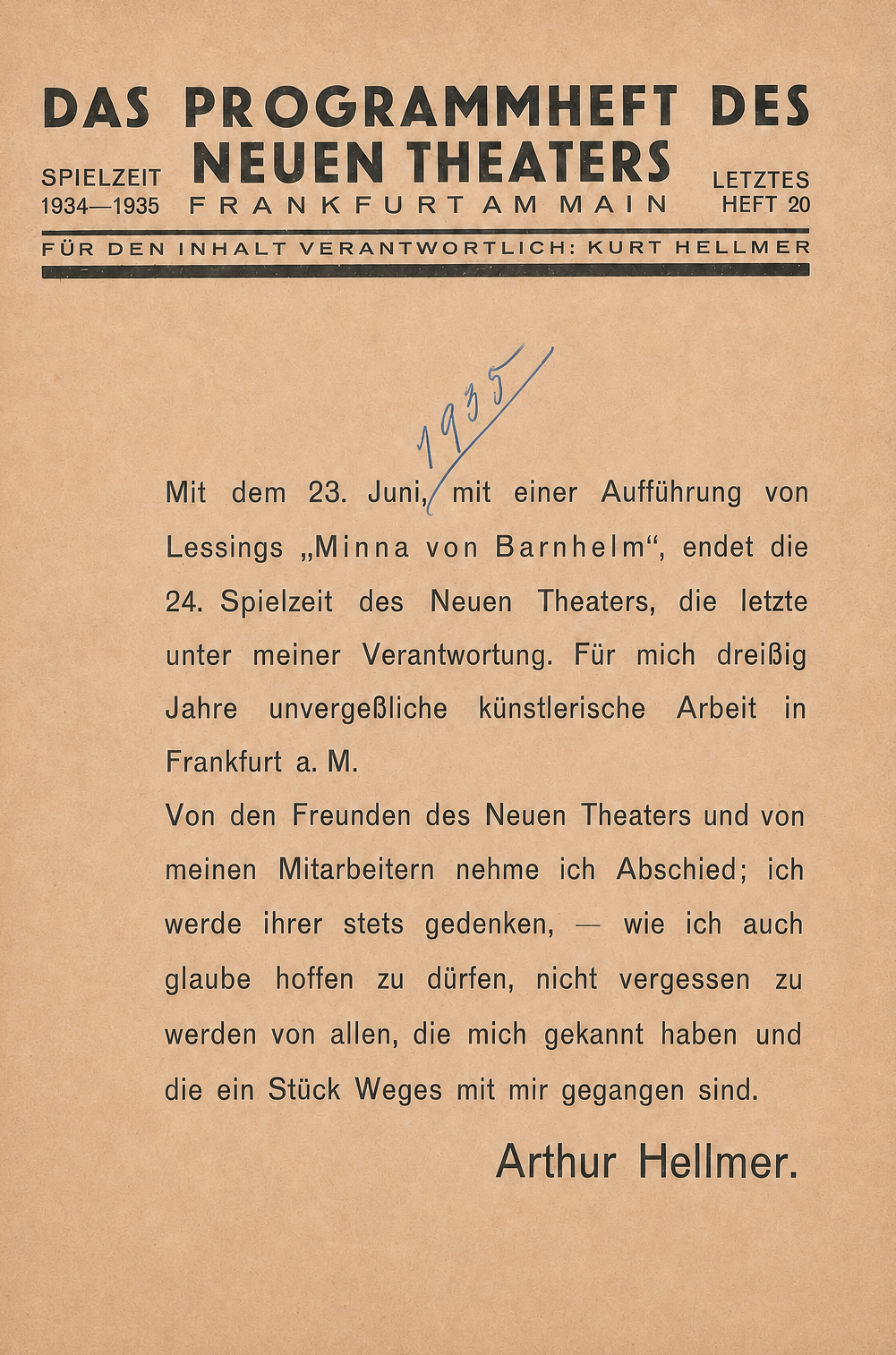
Hellmer was forced out of the house under the Nazi regime in 1935. After the November 1938 pogrom he sold the building to the City of Frankfurt and left for Vienna, and then for exile in England.